How to work out unit prices and compare supermarket packs
Divide the price by the quantity: a 1.25 L bottle at $6.20 is 6.2 ÷ 1.25 = $4.96 a litre. Plus per 100 g, mL to litres, “2 for $5” deals and label rounding.
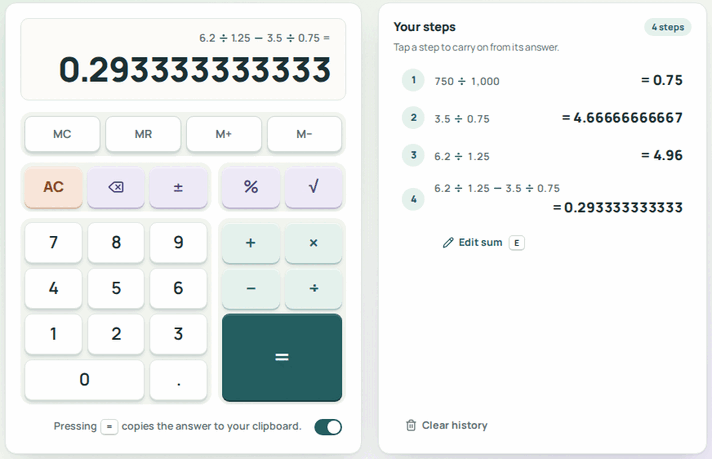
To work out a unit price, divide the price by the quantity in the unit you want to compare, such as litres, kilograms or 100 grams. For a 1.25 litre bottle of juice at $6.20, 6.2 ÷ 1.25 = shows 4.96, so it costs $4.96 a litre, while a 750 mL bottle at $3.50 works out at $4.67 a litre and is the better buy.
The rice, lemon, laundry detergent and orange juice prices come from the ACCC, and the rest are made up. Every sum was run through stepbystepcalculator.com, so the displays quoted are the ones you’ll see there.
How do you work out a unit price?
Divide the price by the number of grams, millilitres or items, then multiply by the size of the unit on the label. The Unit Pricing Code defines a unit price as “the price (including GST) for a grocery item per unit of measurement” (clause 3).
The ACCC’s guide for grocery retailers prices a 500 g bag of rice at $2.00. 2 ÷ 500 × 100 = shows 0.4, which is the guide’s $0.40 per 100 grams.
For a price per kilogram, multiply by 1,000 instead of 100. The ACCC’s Unit prices for groceries page says a retailer can show a lemon as “$1.50 per lemon” and can also give “the average weight of a lemon as 80 grams and the unit price of $18.75 per kg”. 1.5 ÷ 80 × 1000 = shows 18.75, the same $18.75. stepbystepcalculator.com works ÷ and × from left to right, so you can type each of these as one sum (why the order matters).
Which unit does a supermarket shelf label use?
Clause 10 of the Unit Pricing Code sets the default units: “per 100 grams” for an item supplied by weight, “per 100 millilitres” for one supplied by volume, with per metre, per square metre and per item for the rest. Clause 11 then gives 18 grocery categories their own unit. The common ones are:
| Grocery category | Unit on the label | Where the Unit Pricing Code sets it |
|---|---|---|
| Items supplied by weight, such as rice or pasta | per 100 grams | Clause 10 |
| Items supplied by volume | per 100 millilitres | Clause 10 |
| Beverages, including beverage concentrates | per litre | Clause 11, item 10 |
| Cheese, and flour | per kilogram | Clause 11, items 9 and 16 |
| Meat, and fruit and vegetables | per item, or per kilogram if supplied by weight | Clause 11, items 7 and 8 |
| Laundry liquids and powders | per item, per kilogram or per litre | Clause 11, item 17 |
| Toilet paper with 41 or more sheets on the roll | per 100 items | Clause 11, item 12 |
The ACCC’s Unit prices for groceries page says “Most supermarkets, large grocery stores, and online grocery stores must display unit pricing, in store, online and in advertising.” Clause 9 exempts some categories, alcoholic beverages among them, so a bottle of wine needn’t carry a unit price.
Is the bigger pack always cheaper per litre?
No. The shelf price can’t tell you, so work out the price per litre of each pack and compare those. The ACCC’s Unit pricing campaign resources page puts it as “The bigger pack isn’t always the better deal.”
Juice is a beverage, so the Unit Pricing Code prices it per litre, and both bottles have to be in litres before you divide: 750 ÷ 1000 = shows 0.75, so 750 mL is 0.75 litres.
| Bottle | Keys | Display | Price per litre |
|---|---|---|---|
| 750 mL at $3.50 | 3.5 ÷ 0.75 = | 4.66666666667 | $4.67 |
| 1.25 L at $6.20 | 6.2 ÷ 1.25 = | 4.96 | $4.96 |
The 750 mL bottle is 29 cents a litre cheaper. On stepbystepcalculator.com, 6.2 ÷ 1.25 − 3.5 ÷ 0.75 = shows 0.293333333333, because both divisions come before the subtraction. The ACCC’s guide has a case where the bigger bottle wins: 2.5 litres of laundry detergent at $7.62 against 1.5 litres at $5.74. 7.62 ÷ 2.5 = shows 3.048 and 5.74 ÷ 1.5 = shows 3.82666666667, which the guide prints as $3.05 and $3.83 per litre.
How do you work out the unit price of a “2 for $5” deal?
Divide the deal price by the total quantity in all the packs it covers. Two 500 g packets of pasta for $5 is $5 for 1,000 g, so 5 ÷ 1000 × 100 = shows 0.5, or $0.50 per 100 g.
A multi-buy has to carry a unit price too. The ACCC’s Unit prices for groceries page says “Unit pricing must be displayed where 2 or more of the same grocery items are offered for a single price”. Check the deal against every size on the shelf. Say one 500 g packet is $3.20 and a 1 kg bag of the same pasta is $4.40:
| Option | Keys | Display | Price per 100 g |
|---|---|---|---|
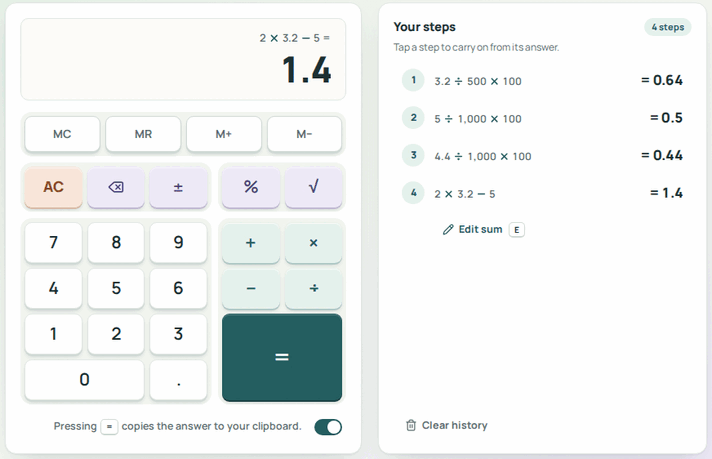
| One 500 g packet at $3.20 | 3.2 ÷ 500 × 100 = | 0.64 | $0.64 |
| Two 500 g packets for $5 | 5 ÷ 1000 × 100 = | 0.5 | $0.50 |
| One 1 kg bag at $4.40 | 4.4 ÷ 1000 × 100 = | 0.44 | $0.44 |
The pasta deal saves $1.40 on two single packets (2 × 3.2 − 5 = shows 1.4), yet the 1 kg bag is still 6 cents per 100 g cheaper than the deal, a difference of 60 cents a kilogram. The ACCC’s guide works a two-for-one offer the same way. A 2 litre orange juice at $4.57 is $2.29 a litre, and two for the price of one is 4.57 ÷ 4 =, which shows 1.1425, and the guide gives $1.14 per litre. A bundle of different products for one price, such as the guide’s mouthwash, toothpaste and dental floss, is exempt under clause 8.
Why your answer and the shelf label can differ by a cent
Shelf labels are rounded to the cent and stepbystepcalculator.com isn’t. Clause 10 of the Unit Pricing Code says “The unit price is to be worked out to the nearest 1 cent (rounding 0.5 cents upwards).” For the ACCC guide’s 2 litre orange juice at $4.57, 4.57 ÷ 2 = shows 2.285 on stepbystepcalculator.com, and the guide gives $2.29. stepbystepcalculator.com shows up to 12 significant digits (why 12) and doesn’t round to cents, so the rounding is yours.
Clause 10 also lets a unit price under $1.00 be shown in whole cents, so the pasta deal’s $0.50 per 100 g can read 50c per 100 g. To compare a price per 100 g with one per kilogram, multiply the per 100 g figure by 10: the ACCC guide’s 500 g bag of rice at $0.40 per 100 g is 0.4 × 10 =, which shows 4, or $4.00 a kilogram. If your answer is more than a cent away from the label, check the label’s unit first.
Is the Unit Pricing Code changing?
Not so far. On 24 November 2026 the 2021 code was still in force, unamended. Treasury consulted on a shrinkflation notice and consistent units of measure in September 2025, and the Government’s May 2026 response says it is still considering the outcomes.
The Government announced on 2 October 2024 that it would strengthen the code. A Treasury consultation then ran from 1 to 19 September 2025 on options including “Introducing a new shrinkflation notification regime” and “Addressing inconsistency in units of measure”. The Government’s response to the Senate supermarket prices committee, dated May 2026, says it “is currently considering outcomes of the consultation”. The Federal Register of Legislation listed the 2021 regulations as in force on 24 November 2026, with no compilations and no known future amendments, so the figures in this article follow the 2021 rules.
This article covers the arithmetic only and is general information, not financial advice (see the terms of use).
Sources
- Competition and Consumer (Industry Codes—Unit Pricing) Regulations 2021 (Federal Register of Legislation, made 23 July 2021, in force from 1 October 2021, accessed 24 November 2026): Schedule 1, the Retail Grocery Industry (Unit Pricing) Code of Conduct, clauses 3, 8, 9, 10 and 11, and the version history with no amendments.
- Unit prices for groceries (Australian Competition and Consumer Commission, accessed 24 November 2026): which stores must show unit prices, the lemon example, and multi-buys and bundles.
- Unit pricing: A guide for grocery retailers (Australian Competition and Consumer Commission, October 2021): the rice, laundry detergent, orange juice and bundled grocery pack examples.
- Unit pricing campaign resources (Australian Competition and Consumer Commission, accessed 24 November 2026): the “Bigger isn’t always better value” video.
- Cracking down on shrinkflation at the checkout (Treasury Ministers, media release, 30 August 2025): the consultation options and dates.
- Australian Government response to the Senate Select Committee on Supermarket Prices (The Treasury, May 2026): the 2 October 2024 announcement and where the consultation stood, under Recommendation 9.